

Every cybersecurity startup eventually reaches the same conclusion:
We need a channel.
The direct sales team is stretched. Customer acquisition is getting expensive. Growth is slower than expected. Investors want more pipeline, and leadership sees partners as the fastest way to expand the company’s reach.
So the company hires a channel manager.
It buys a partner relationship management platform.
It creates a partner agreement, announces a new program, signs up dozens of companies, and maybe even prints a few hoodies.
Six months later, the dashboard shows 200 registered partners and almost no partner revenue.
The startup assumes the channel failed.
But the channel was never the real problem.
The company tried to scale a sales motion it had not finished building.
That is the core lesson from Episode 71 of Channel Surfers: a partner cannot scale what a startup has not figured out yet.
The channel is not an ATM. It is not a shortcut around product-market fit. It is not a group of companies waiting to hand your startup qualified opportunities.
The channel is a scale engine.
But it can only scale something that already works.
The Most Dangerous Channel Expectation
One of the biggest warning signs appears when a startup says:
“We just need partners to bring us leads.”
That statement usually means the company is not ready for partners.
Partners already work with hundreds, and sometimes thousands, of vendors. Every vendor believes its product is different. Every vendor wants introductions. Every vendor wants access to the partner’s customer relationships.
Partners are not looking for another company that wants something from them.
They are looking for companies that can help them:
Solve a real customer problem
Create qualified pipeline
Increase deal value
Add profitable services
Protect customer relationships
Close business faster
Deliver a better customer outcome
A startup must bring more than a product.
It must bring a clear reason for the partner to care.
That means founders need to stop asking, “How do we get partners to sell our product?”
The better question is:
“What can we build with a partner that neither company could deliver as effectively alone?”
That shift changes the entire channel strategy.
The Startup Channel Readiness Model
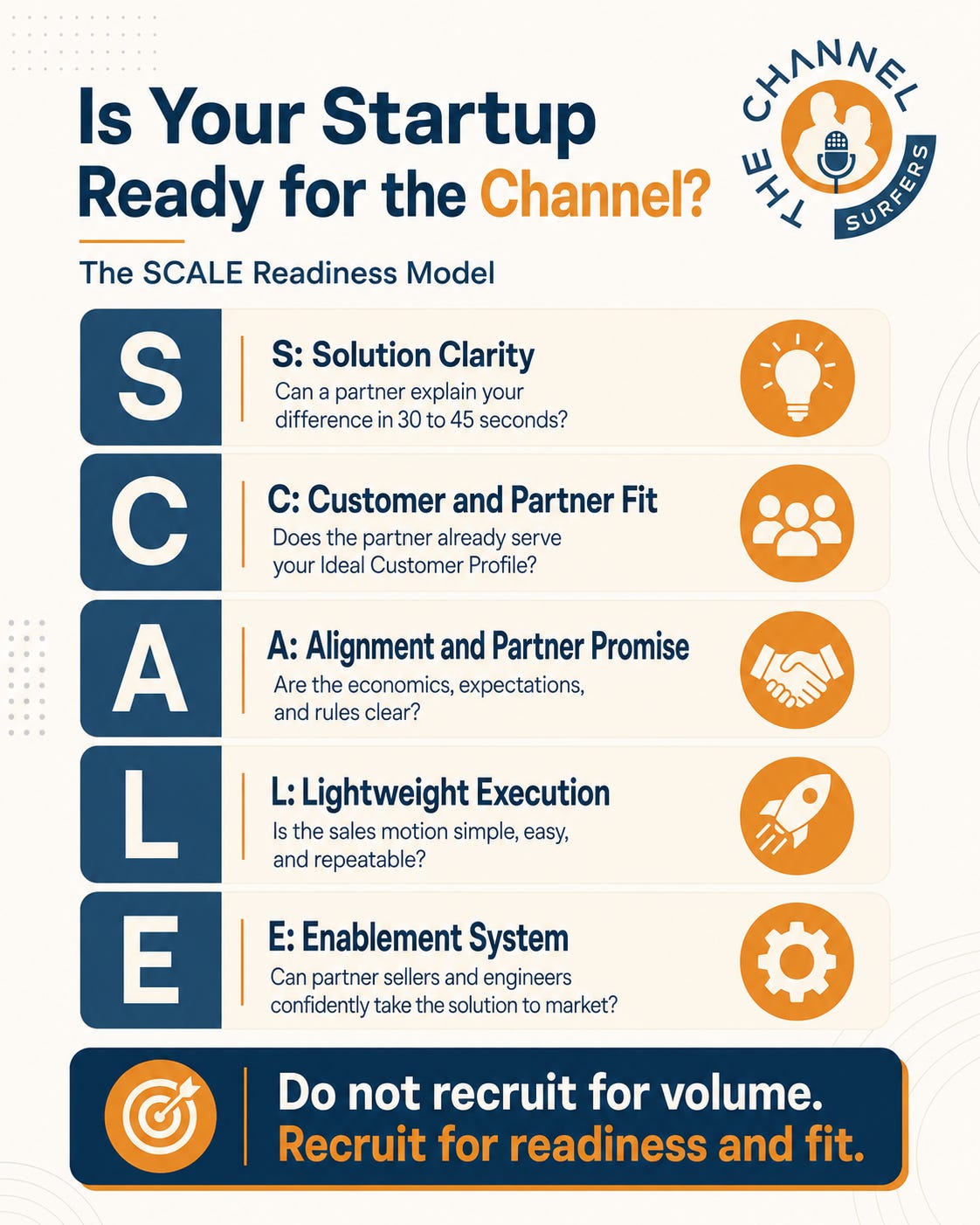
Before recruiting partners, a startup should have five basic pieces in place.
We call this the SCALE Readiness Model.
S: Solution Clarity
The startup must clearly understand the problem it solves.
Not the full list of product features.
Not every possible use case.
Not every market the product could eventually serve.
The company needs a simple explanation of:
The problem
Who has the problem
Why the problem matters
What changes after the solution is implemented
Why the solution is different
A partner should be able to understand and repeat the value proposition in 30 to 45 seconds.
When the company cannot explain its difference clearly, the partner will not be able to explain it to a customer.
Better is not enough.
Different must be clear.
C: Customer and Partner Fit
Every market is not your market.
Every partner is not your partner.
The startup first needs a clear Ideal Customer Profile.
That profile should identify:
Company size
Industry or vertical
Technology environment
Common business problem
Primary buyer
Trigger event
Typical use case
Expected sales cycle
Once the customer profile is clear, the company can build an Ideal Partner Profile.
The right partner should already have relationships with the customers the startup wants to reach. The partner should understand the problem, have the right technical capabilities, and see a real business opportunity.
Customer fit and partner fit must connect.
A large partner with thousands of sellers may look attractive, but size does not guarantee alignment.
For many startups, one committed lighthouse partner is more valuable than 100 inactive partner agreements.
A: Alignment and the Partner Promise
Before recruiting a partner, the startup needs a clear partner promise.
The partner promise explains what the partner can expect from the relationship.
It should answer questions such as:
Which customers are we pursuing together?
Which use cases will we lead with?
How will opportunities be registered?
How will direct and partner teams work together?
Who owns each part of the sales process?
How will conflicts be handled?
What margin or compensation will the partner receive?
What support will the vendor provide?
How quickly will partners be paid?
This does not need to be a 40-page program guide.
It needs to be clear, usable, and fair.
Trust is built when a company does what it says it will do. That includes communicating clearly, respecting the partner’s customer relationships, and paying the partner correctly and on time.
A partner program without trust is only a contract.
L: Lightweight and Repeatable Execution
Startups frequently make one of two process mistakes.
They create too much process, or they create almost none.
A startup does not need complex tiers, long certifications, dozens of rules, or a large technology stack on day one.
It does need enough structure so that everyone understands how to work together.
The first partner motion should be:
Simple
Easy to understand
Easy to execute
Easy to measure
Repeatable
A basic program may only need two opportunity types.
Partner-sourced opportunities: The partner identifies and helps develop the opportunity.
Vendor-sourced opportunities: The startup brings the opportunity to a partner to help accelerate, transact, or support the deal.
Both types create value.
The goal is not to debate who gets all the credit. The goal is to create a structure that moves opportunities forward and gives each participant a reason to stay engaged.
E: Enablement as an Ongoing System
Enablement is not a training event.
It is not a portal full of documents.
It is not a certification that a partner completes once and forgets.
Real enablement continues throughout the relationship.
It includes:
Technical education
Sales positioning
Competitive differentiation
Use-case development
Account mapping
Field alignment
Deal support
Customer proof
Joint business reviews
Continuous feedback
Technical enablement is especially important.
The partner’s technical team often becomes the trusted advisor for the sales representative. When the technical team understands and believes in the solution, it can validate the opportunity and give the sales team confidence.
Start with simple tools.
A strong one-page or two-page battle card can be more useful than a large training library.
The battle card should explain:
Who the solution is for
The business problem
The primary use cases
Key discovery questions
Competitive positioning
Important differentiators
The next step
Partners need something they can understand quickly and use in a real customer conversation.
Give Before You Expect to Get
Startups often approach partners with their hands out.
They ask for introductions, leads, account access, and pipeline before proving that the relationship will create value.
The better approach is to give first.
Bring a partner into an existing opportunity.
Share a focused account list.
Provide customer evidence.
Help create a sales play around a specific use case.
Support a joint event.
Build a service opportunity around the product.
In cybersecurity, services can be one of the strongest reasons for a partner to engage.
A partner may be able to wrap the product with:
Implementation
Assessment services
Managed services
Advisory services
Integration
Remediation
Ongoing support
The startup earns software revenue.
The partner earns product margin and services revenue.
The customer receives a more complete outcome.
That is a real better-together story.
It also gives the partner an economic reason to invest time, technical resources, and customer credibility into the relationship.
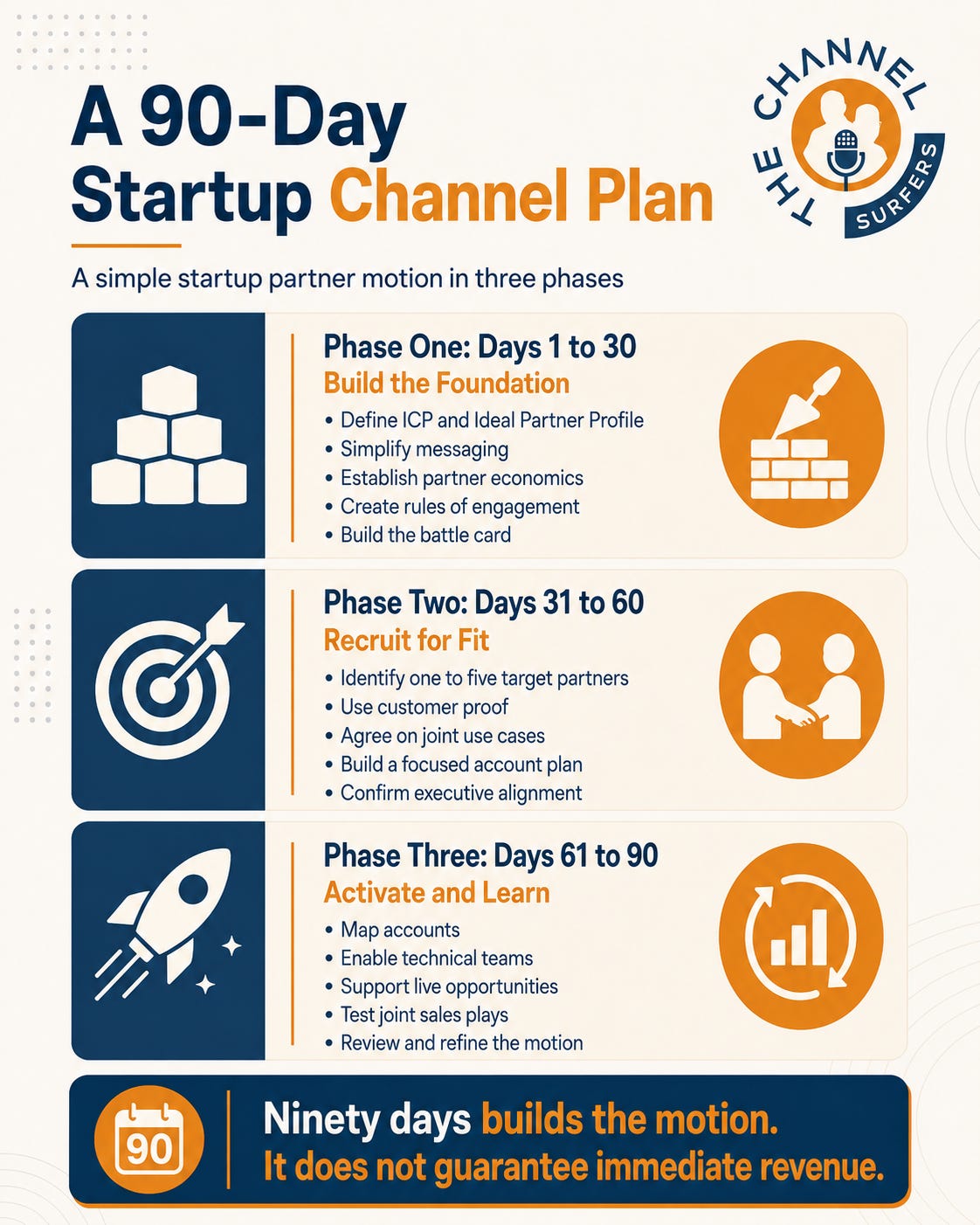
A Practical 90-Day Startup Channel Plan
A 90-day plan does not guarantee revenue within 90 days.
It creates the foundation needed to begin producing revenue.
The company will still be influenced by its normal sales cycle. A product with a nine-month sales cycle does not suddenly become a three-month sale because a partner is involved
.
The first 90 days should focus on readiness, recruitment, and activation.
Days 1 to 30: Build the Foundation
During the first month, the startup should:
Confirm the Ideal Customer Profile
Define the Ideal Partner Profile
Simplify the value proposition
Identify the strongest use cases
Document competitive differentiation
Create the partner promise
Establish basic rules of engagement
Create a channel-friendly pricing and margin model
Build the initial battle card
Gain clear executive commitment
At the end of this phase, everyone should understand why the company is using the channel and what success will look like.
Days 31 to 60: Recruit for Fit
The goal is not to recruit as many partners as possible.
The goal is to identify a small number of partners with a real reason to engage.
For some startups, that may be three to five partners.
For others, it may be one lighthouse partner.
Recruitment should be supported by:
Customer success stories
Clear use cases
A focused account strategy
Defined partner economics
Technical support
A realistic joint plan
A partner agreement is not activation.
The relationship only becomes meaningful when people from both companies begin working on customers, accounts, and opportunities together.
Days 61 to 90: Activate and Learn
During the final phase, the startup should:
Map target accounts
Identify shared customer opportunities
Conduct technical enablement
Run seller-to-seller introductions
Bring the partner into active opportunities
Build one or two joint sales plays
Test the deal-registration process
Review early pipeline
Collect feedback
Refine the program
This is where the program moves from theory to execution.
The first partner will expose gaps that were not visible on paper.
That is not failure, that is how the company learns what needs to change before expanding the program.
Eight Mistakes That Can Sink a Startup Channel Program
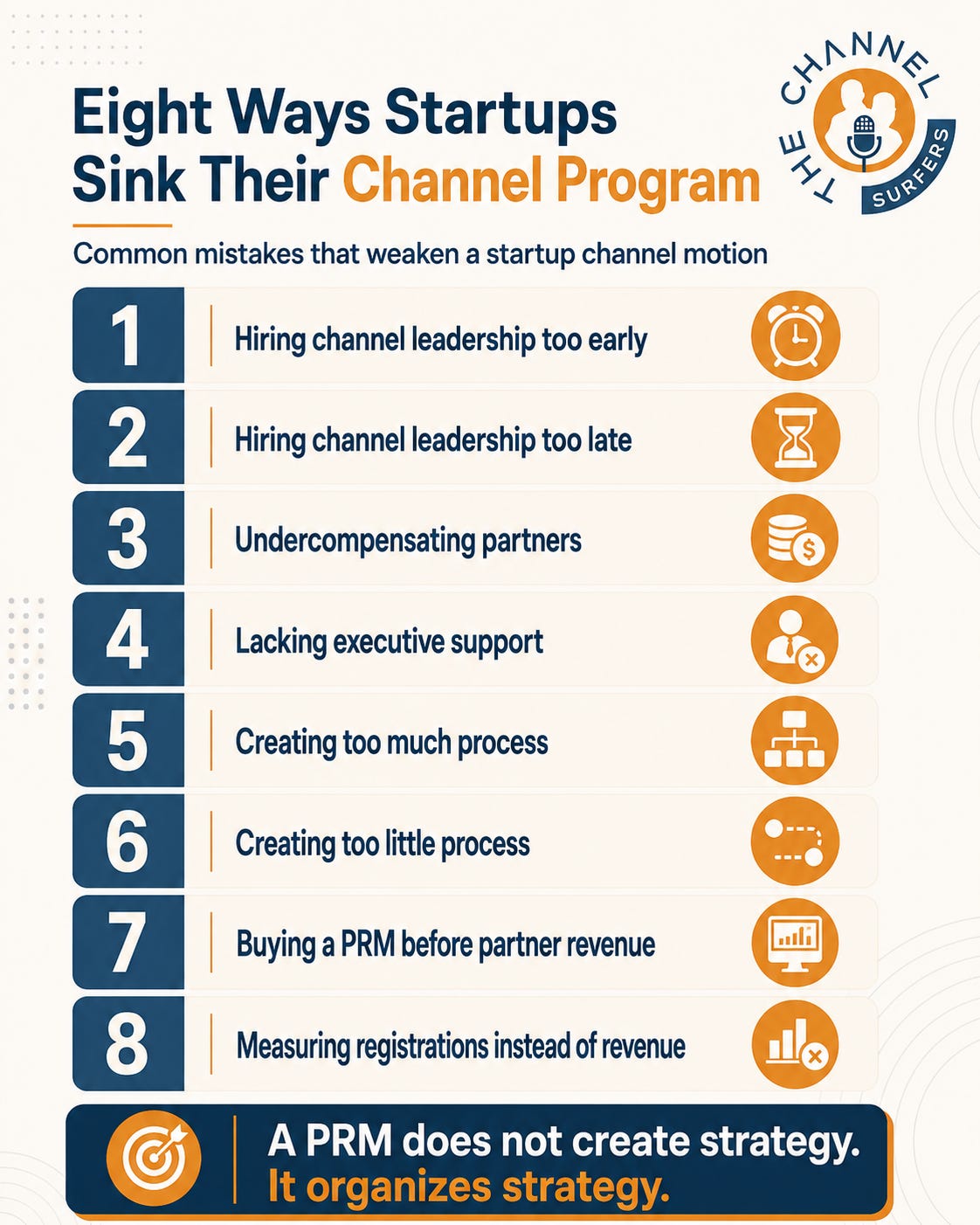
1. Hiring a Channel Leader Too Early
If the company has no customers, no repeatable use case, no clear buyer, and no product-market proof, the channel leader will spend most of the time trying to solve problems that should be owned by the founders and direct sales team.
Early direct sales teach the company what partners will eventually need to know.
Do not skip that learning stage.
2. Hiring a Channel Leader Too Late
Waiting too long also creates risk.
Once the company has customer proof, a repeatable use case, and a defined market, the channel can help extend reach without requiring the startup to build a massive direct sales organization.
Channel planning should begin before growth stalls.
3. Undercompensating Partners
Partners understand vendor economics.
They know which vendors provide strong margins, protect opportunities, and create services revenue.
A startup does not always need to offer the highest margin, but the economics must justify the partner’s time and effort.
4. Operating Without Executive Support
A channel program cannot survive as an experiment owned by one channel manager.
Founders, sales leaders, marketing leaders, and product leaders must support the partner route to market.
Partners can quickly tell when the direct team does not respect the program.
5. Creating Too Much Process
Complex tiers, heavy certifications, long agreements, and rigid requirements can prevent a new relationship from gaining momentum.
Build what is needed now.
Add structure as revenue and complexity grow.
6. Creating Too Little Process
A handshake is not a channel strategy.
Without rules of engagement, pricing, ownership, communication, and opportunity management, confusion will eventually damage trust.
Keep the process simple, but make it clear.
7. Buying a PRM Before the Program Produces Revenue
A PRM does not create a strategy.
It organizes the strategy.
Technology can support recruitment, enablement, communications, deal registration, and reporting. But it cannot fix unclear positioning, weak partner economics, poor activation, or a lack of executive support.
Prove the motion first.
Then invest in technology that helps it scale.
8. Measuring Registrations Instead of Revenue
The number of signed partners is not the goal.
The number of deal registrations is not the goal.
The real goals are:
Partner activation
Qualified pipeline
Opportunity progression
Conversion
Customer outcomes
Revenue
A program with five active partners can outperform a program with 500 registered partners.
Activity is useful but it is “Outcomes” that matter most! matter.
The Real Job of a Startup Channel Leader
The channel leader’s job is not to collect logos.
It is not to manage a portal.
It is not to wait for partners to submit leads.
The job is to create a working revenue motion between the startup and a focused group of partners.
That requires strategy, but it also requires field execution.
It means sitting with partner teams, supporting deals, mapping accounts, refining messages, solving conflicts, and making the relationship easier to use.
The channel leader becomes an embedded revenue accelerator.
The best channel programs are not built by announcing them.
They are built one opportunity, one partner, and one customer outcome at a time.
Closing Thought
The channel can give a startup reach, credibility, customer access, technical expertise, and feet on the street.
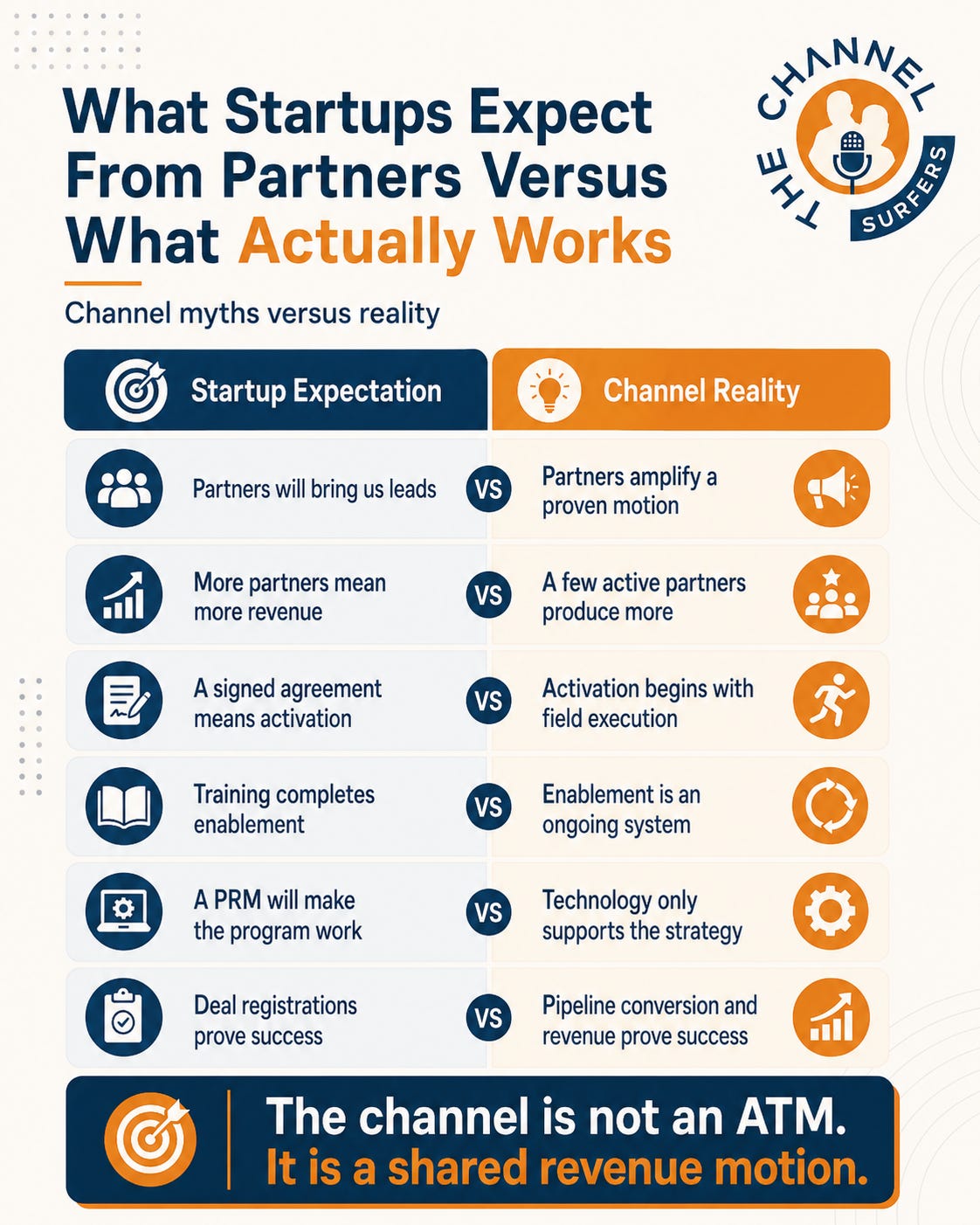
But those advantages only appear when the company gives partners something worth scaling.
Start with the fundamentals.
Know the problem.
Know the customer.
Choose the right partner.
Create a clear promise.
Keep the motion simple.
Enable the people doing the work.
Bring value before asking for value.
Then scale what proves itself.
Because a partner cannot scale what your startup has not figured out yet.
Key Takeaways
The channel is a scale engine, not a replacement for product-market fit.
Define your Ideal Customer Profile before building your Ideal Partner Profile.
Recruit a few high-fit partners rather than collecting agreements.
Enablement must be an ongoing system, not a one-time training event.
Measure activation, pipeline, conversion, and revenue instead of registrations.
Community Question
What is the first thing a startup should prove before it begins recruiting partners?
Share your perspective in the comments. We would like to hear what founders, channel leaders, and partners are seeing in the market.
Call to Action
Listen to Episode 71 of Channel Surfers, “The Startup’s Guide to Building a Channel Program,” for the complete conversation between Jeff Lennon and John McCabe.
Subscribe to the Weekly Wave and share this article with a founder or channel leader who is trying to build a partner motion from the ground up.
Listen in to learn more. The waves are coming constantly.